Bedding • Nursery guides
Naturepedic Crib Pads: When to Choose Flat or Fitted
A crib mattress pad can help protect a mattress from the spills and dampness that arrive with everyday family life. Naturepedic’s flat and fitted waterproof crib pads use soft organic cotton layers around a thin moisture barrier, but their shapes change how they sit on the mattress and how you handle the bedding. The useful choice is the one that fits your particular mattress, suits your routine, and can be used in line with current safe-sleep guidance.
Updated October 24, 2026
In a nursery, the mattress is a quiet workhorse. It supports sleep night after night, while sheets are changed, laundry piles up, and small accidents happen. A crib pad is an additional layer intended to protect that mattress. Choosing between a flat crib mattress pad and a fitted crib mattress pad is less about which style is universally better and more about fit, setup, care, and the instructions supplied with the mattress and pad.
Naturepedic’s waterproof options share a basic purpose: organic cotton flannel provides the upper surface, organic cotton muslin forms the lower surface, and a thin inner membrane helps keep liquid from passing through to the mattress. Both are described as free of vinyl or PVC, phthalates, latex, wool, and chemical flame retardants. Their construction is designed to provide a moisture barrier without making the pad a bulky comfort layer.
The difference is in how each format is secured. A flat pad lies on the mattress and is held in place by the fitted crib sheet placed over it. A fitted pad has elastic around its edges, so it wraps around the mattress much like a fitted sheet. That distinction matters when you are checking whether a pad is compatible with your crib mattress and deciding how bedding changes will work in your household.
First, understand what a crib pad does
A waterproof crib pad is a protective bedding accessory, not a substitute for the mattress or a way to change the mattress’s intended firmness. Its role is to create a barrier between everyday moisture and the mattress itself. In the Naturepedic designs described here, the barrier is a thin layer enclosed between cotton fabrics. The cotton layers provide the textile surface; the inner membrane is the part intended to impede liquid.
That distinction is worth keeping in mind when reading descriptions. “Waterproof” speaks to liquid protection, while “breathable” describes a material-quality claim that can vary with the construction. Neither phrase alone tells you whether a particular pad is appropriate for a particular crib mattress, whether it will fit tightly, or how it should be placed. Those answers come from the product’s dimensions and instructions, as well as the crib and mattress guidance.
The flat Naturepedic waterproof organic cotton crib mattress pad is designed to be layered on the mattress beneath a fitted sheet. The fitted version has elastic all the way around for a snug wrap. Both are listed at 28 by 52 inches, the standard crib-mattress dimensions stated for these products. Even when the nominal dimensions match, checking your mattress label and the product instructions is important: mattress thickness, construction, and the manufacturer’s permitted accessories can affect fit.
How a flat crib mattress pad works
A flat crib pad is a panel rather than a pocketed cover. You place it over the mattress and then stretch the fitted sheet over both layers. The sheet is what holds the pad in position. This can make the format straightforward when you are already changing sheets, or when you prefer a pad that does not wrap around the mattress edges.
Its uncomplicated shape can also be a practical consideration for storage and handling. A flat pad has no elastic skirt to pull over mattress corners. But because it relies on the fitted sheet to keep it in place, the sheet must fit correctly and remain secure. A pad that bunches, shifts, or creates an uneven surface is not a suitable setup. Before use, check the finished arrangement carefully and follow all instructions for the crib mattress, pad, and sheet.
The flat design may suit a household that wants a moisture barrier under the sheet but does not need elastic around the mattress perimeter. It can also be useful when the mattress maker specifies a particular layering arrangement. The relevant question is not whether a flat pad is inherently simpler in every nursery; it is whether it can be placed smoothly and securely on the mattress as directed.
How a fitted crib mattress pad differs
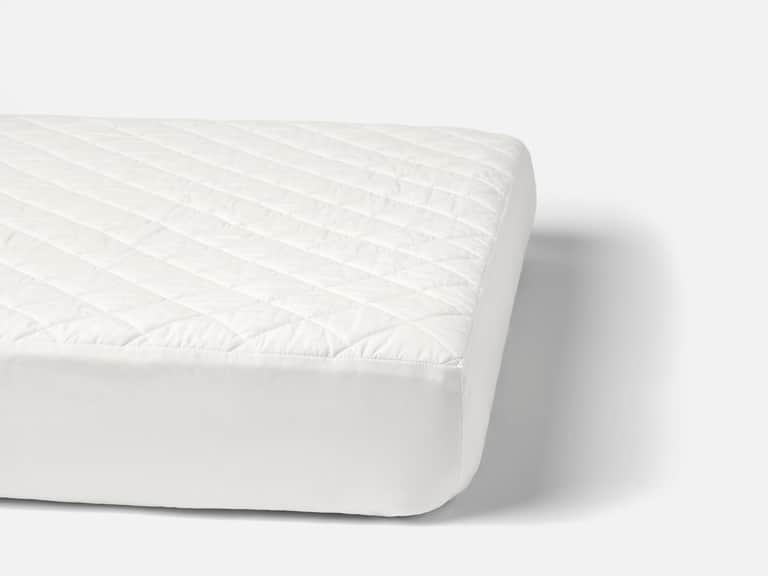
A fitted crib pad uses elastic around the edge to hold it snugly against the mattress. Rather than relying on the sheet alone to retain the pad, it is shaped to wrap around the mattress. The Naturepedic fitted waterproof organic cotton crib mattress pad is described as having elastic all the way around and a thin waterproof inner layer between cotton fabrics.
For caregivers who change bedding frequently, the fitted construction may feel familiar: stretch it over the mattress corners, then place the fitted sheet on top if the product instructions call for that arrangement. The elastic can help the pad stay in position during ordinary use, though it does not remove the need to check the fit. Edges should sit as intended, and the pad should not be stretched in a way that interferes with the mattress or creates loose fabric.
Fitted does not mean one size fits every mattress. Confirm the crib mattress dimensions and thickness, and compare them with the pad’s stated specifications. A pad that is too small may not fit as designed; one that is too large or incompatible may not lie smoothly. If you are unsure, consult the mattress maker’s guidance rather than improvising a combination of layers.
Flat vs. fitted: a practical comparison
| Consideration | Flat crib pad | Fitted crib pad |
|---|---|---|
| How it stays in place | Held beneath the fitted sheet | Elastic around the edge wraps it to the mattress |
| What to check | That it lies smoothly and remains secure under a correctly fitted sheet | That the elastic fits the mattress and the pad sits evenly |
| A possible routine fit | Useful when you prefer a simple panel or the mattress instructions call for this arrangement | Useful when you prefer a pad that is shaped to stay around the mattress |
| Care considerations | Follow the product’s washing and drying instructions | Follow the product’s washing and drying instructions |
This comparison describes construction, not a ranking. Both formats are intended to protect the mattress, and neither should be chosen on the assumption that one is automatically safer or more comfortable. Correct fit and use matter more than the label “flat” or “fitted.”
Safe sleep comes before convenience
For an infant’s sleep space, follow current safe-sleep recommendations from trusted public-health authorities, including the guidance provided by the American Academy of Pediatrics and the U.S. Consumer Product Safety Commission. In general, the sleep surface should be firm, flat, and designed for the crib; use only bedding and accessories approved for that mattress and follow the crib and mattress manufacturers’ instructions. Keep loose items out of the sleep space.
A mattress pad is not a reason to add extra cushioning, a topper, or layers that the mattress maker does not permit. Do not use a pad if it cannot be secured as directed or if it changes the mattress surface in a way that conflicts with safe-sleep guidance. After making the bed, confirm that the fitted sheet is secure and the surface is smooth, with no loose or bunched material. If the mattress or accessory instructions are unclear, contact the manufacturer or a qualified child-safety resource for clarification.
Water resistance should also not be confused with a guarantee against every leak, stain, or hygiene concern. A pad can help protect a mattress, but it still needs timely cleaning after a spill and complete drying before it is used again. Follow the care label rather than relying on general assumptions about cotton or waterproof layers.
Choosing for your nursery routine
Think about what happens on an ordinary night in your home. How often do you expect to change the sheet? Do you want the pad attached around the mattress, or are you comfortable placing a flat layer beneath the sheet? Is the crib mattress a standard size, and does its maker allow a separate pad? These practical questions can narrow the choice more reliably than broad claims about convenience.
- Choose a flat format to consider if you want a simple panel that goes beneath the fitted sheet and the product and mattress instructions permit that arrangement.
- Choose a fitted format to consider if you prefer elastic around the mattress edge and can confirm the dimensions and thickness are compatible.
- Pause before buying if you cannot verify fit, the mattress instructions prohibit added pads, or the proposed setup does not remain smooth and secure.
- Keep the purpose modest: a pad protects the mattress from moisture; it should not be used to make an unsuitable sleep surface softer or thicker.
If you are comparing the Naturepedic flat crib mattress pad with its fitted counterpart, the central construction is similar: organic cotton flannel and muslin surround a thin waterproof membrane. The shape and method of attachment are the meaningful differences. Both listings describe machine washing and drying, but always use the specific care instructions supplied with the pad, since heat, cycle, and detergent recommendations can affect fabric and barrier longevity.
Care, cleaning, and repeat use
Accidents are part of nursery life, so care instructions are more than fine print. Naturepedic’s product descriptions state that the waterproof crib pads can be machine washed and dried. Check the label for the permitted water temperature, cycle, detergent, and drying method. Avoid substituting a more aggressive routine simply because the pad appears sturdy: repeated high heat or unsuitable chemicals can affect materials over time.
After washing, make sure the pad is completely dry before putting it back on the mattress. Damp fabric trapped beneath a sheet is uncomfortable and can encourage lingering odors. Inspect the pad periodically for tears, thinning, stretched elastic, or other damage. If the barrier appears compromised, or the pad no longer fits securely, discontinue use and consult the manufacturer’s replacement guidance.
It is sensible to have a clean sheet ready when you remove soiled bedding, but do not solve a laundry problem by stacking multiple pads or adding loose layers to the crib. Instead, keep the sleep surface consistent with safe-sleep recommendations and the instructions for the products in use. A backup pad can be useful only when each pad is compatible and used in the manner its maker specifies.
What organic cotton and certification tell you
Material descriptions can help families understand what touches the mattress. These Naturepedic pads are described as using organic cotton flannel and muslin, with a thin waterproof membrane inside. The product listings also state that the pads do not contain vinyl or PVC, phthalates, latex, wool, or chemical flame retardants. Those details are product-specific descriptions, not proof that every crib pad with cotton fabric has the same construction.
When environmental or sourcing claims matter to you, look for the exact certification named by the manufacturer and check what it covers. A certification may apply to particular fibers or stages of production rather than every component in a finished item. For a waterproof crib pad, the cotton layers and the moisture-barrier material are distinct parts of the product; read the full specification instead of assuming a fiber description covers the entire construction.
Material preference is personal, but it does not replace fit, care, or safety checks. An organic label does not make an incompatible pad appropriate for a mattress, and a waterproof membrane does not by itself establish that a product should be used in a particular crib. Use the product’s instructions and current safety guidance together.
A quick decision checklist
- Read the crib and mattress instructions to confirm whether an additional pad is permitted.
- Measure or verify the mattress size and thickness against the pad specifications.
- Decide whether a panel held by the fitted sheet or an elastic-edged fitted design better suits your routine.
- Install the pad exactly as directed, then check that every layer lies flat and secure.
- Review washing and drying instructions before the first use, and inspect the pad after laundering.
- Keep the crib sleep space consistent with current safe-sleep guidance; do not add unapproved cushioning or loose bedding.
Frequently asked questions
Can a flat crib pad be used under a fitted sheet?
The Naturepedic flat waterproof crib pad is described for placement beneath a fitted sheet. Follow the pad and mattress instructions, and make sure the sheet holds the pad smoothly and securely without bunching.
Does a fitted crib pad replace the fitted sheet?
Do not assume it does. The fitted pad is a protective layer, and the product instructions determine how it should be layered. Use a properly fitted crib sheet as directed by the mattress and pad manufacturers.
Are the flat and fitted Naturepedic pads the same size?
The product descriptions list both at 28 by 52 inches. Check your own mattress measurements and the current product specifications before purchase, since nominal sizing alone does not confirm compatibility with every mattress depth or design.
Are these crib pads machine washable?
The supplied Naturepedic descriptions state that the flat and fitted waterproof cotton pads can be machine washed and dried. Follow the care label for the exact cycle and drying method, and ensure the pad is fully dry before use.
Does waterproof mean the mattress can never get wet?
No. A moisture barrier is designed to help protect the mattress, but performance depends on the product’s condition and correct use. Clean spills promptly, inspect the pad, and replace it if damaged or no longer secure.
The simplest choice is the one that fits
A flat crib mattress pad and a fitted crib mattress pad solve the same practical problem in different ways. The flat version sits beneath a fitted sheet; the fitted version uses elastic to wrap around the mattress. With Naturepedic’s options, both are described as organic-cotton designs with a thin waterproof layer, and both are intended to help guard a crib mattress against spills.
Choose by verifying compatibility, considering how you change bedding, and following the instructions that come with the mattress and pad. Above all, keep the infant’s sleep surface firm, flat, and free of unapproved layers or loose items. In a nursery, the most useful protection is the kind that quietly does its job without compromising a secure, simple sleep setup.
This guide is general bedding information, not medical advice. For infant sleep safety, follow current guidance from recognized public-health authorities and the instructions supplied with your crib, mattress, and bedding.